Group Exhibition
Selected works
Installation views
Press release
Mark Maurangi Carrol
Frankie ChowDrew Connor Holland
Georgia MorganFlin Sharp
Bridget Stehli
Elisabeth Sulichessay by Carey Cheng
Hors—an archaic resonance of a creature deeply woven into myth, labour, and memory— serves as the mooring for this group exhibition. Positioned at the dawn of the Fire Horse Year (commencing February 17, 2026), the show moves beyond mere zodiac prophecy. Instead, it treats the lunar cycle’s convergence of animal spirit and the Fire element as a metaphorical engine to explore the friction between ancient cultural emblems and liquid modernity.
Seven artists navigate this volatile temperament, delving into the dualities of the Fire Horse: the tension between inertia and breakthrough, the accumulation of power versus the heat of release, and the thin line separating innovation from the exhaustion of constant momentum.
Georgia Morgan’s baseless ceramics function as speculative artifacts that refuse containment. Influenced by her Tamil-Australian family’s oral history, Morgan creates “future artifacts”—objects that stand in to hold the stories and intent that physical archives could not. By turning belief into “stone”, she petrifies memory to ensure its endurance. Inscribed with the seven-headed flying horse Uchchaihshravas and phrases like “ENERGY CAN’T BE DESTROYED”, her imaginative iconology frames energy as a force that “can only change shape”. Lacking bases, these vessels echo the Fire Horse as an uncontainable, flowing spirit. Morgan’s practice situates power as a cultivated force, accessed through a deep, evolving connection to ancestral knowledge, the laws of nature, and spirituality.
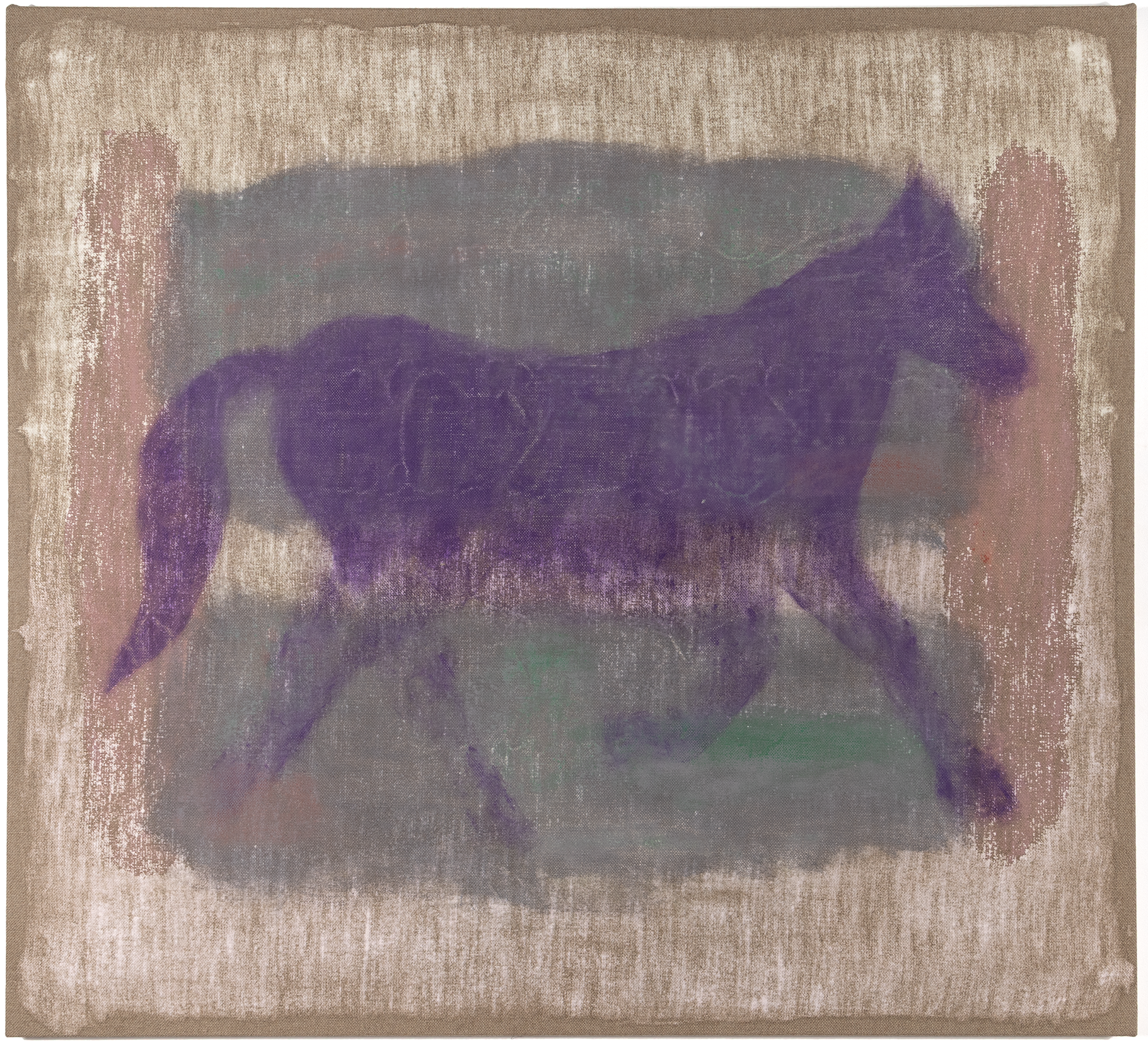
Flin Sharp’s paintings trace human-equine bonds from the artist’s family horse, Sally, to mythic-literary figures, Sooty and Ocyrhoe. Here, the horse emerges as a “wit-bound” companion and witness—a living presence bridging intimate grief with imaginative metamorphosis. Whether through the shared hardship of an outcast in Farseer Trilogy (the loyal horse Sooty and his master FitzChivalry) or the fluid transformations found in Ovid, Sharp explores how stories and lineage shape our connection to the world. Within these worlds, the horse is a spiritual being that defines our capacity for empathy.
These threads of cultural memory culminate in Frankie Chow’s installation, Thirst by Kwaa fu – 龍馬精神! (lung4 maa5 zing1 san4!). With a wry humor, Chow stages the friction between relentless pursuit and total fatigue, intertwining the myth of Kuafu—the giant who perished chasing the sun—to the common Cantonese greeting for vitality (jing-sun). By invoking the cultural fluidity in which the Dragon and Horse are manifestations of one another, the work interrogates the modern cost of maintaining such a spirit: a disciplined drive and performative “vitality” demanded by our contemporary landscape.
The works in Hors do not merely reflect on history; they inhabit the thickened present, where the ancient gallop of the Fire Horse and the contemporary flux of 2026 collide. In this volatile reality, the exhibition acts as a mooring—a point of tethering that allows us to harness this energy, remaining interconnected to the earth and the animal even as the realm undergoes its inevitable transformation.
馬——這頭深植於神話、勞動與記憶的生物,其古老迴響如同一處精神繋泊,為本次群展《Hors》定錨。展期恰逢火馬年伊始(2026年2月17日),超越了單純的生肖預言;展覽將月亮盈虧間,靈性動物與火元素的交會視為一種隱喻動力,藉此探討古老文化象徵與流變的現代性之間的摩擦。七位藝術家駕馭這股幻變氣質,深掘火馬的雙重性:慣性與突破間的張力,力量的積聚與釋放的灼熱,以及游走於創新與持續動能耗竭間那條纖細的界線。
Georgia Morgan 的無底陶瓷作品如同拒絕被禁錮的思辨器物。受其泰米爾裔澳洲家族(Tamil-Australian)的口述歷史啟發,Morgan 創造出「未來文物」——這些物件承載著實體檔案與文獻所無法保存的故事與意圖。透過將信仰轉化為「石頭」,她將記憶石化以確保其永恆。陶器鐫刻著印度神話中的七首飛馬 Uchchaihshravas 以及「能量無法被毀滅」等語句,將能量塑造成一種「僅能變形」的力量。這些無底座的器皿無法承載實體物質,轉而呼應了火馬那種不可遏制、流動不居的靈魂。Morgan的創作將能量定位於一種透過祖先血脈、自然法則與靈性連結而不斷演化的感官能力。
Flin Sharp 的畫作追溯了人馬之間深厚的情感羈絆,從藝術家的家族馬匹 Sally,延伸至神話與文學中的象徵性角色 Sooty 與 Ocyrhoe。在此,馬匹化身為「心靈感應」(Wit-bound)的伴侶與見證者——這份鮮活的存在,將親密的哀慟與想像的蛻變連結在一起。無論是透過《遠見者三部曲》(Farseer Trilogy)中被邊緣化的棄兒(忠馬 Sooty 與其主人 FitzChivalry)所共享的艱辛,還是奧維徳(Ovid)《變形記》中的流動轉化,Sharp 探討了敘事與血脈如何形塑我們與世界的連結。在這些感官世界中,馬不僅是勞動的生靈,更是定義了人類同理心能力的靈魂體。
這些文化記憶的脈絡在 Frankie Chow 的裝置作品《Thirst by Kwaa fu – 龍馬精神! (lung4 maa5 zing1 san4!) 》中達到巔峰。周氏以幽默手法呈現追逐與疲憊間的張力,將「夸父追日」的神話與廣東話日常問候語「精神」相扣連。藉著華語語境中「龍馬」互為化身的意象,作品質疑當代社會要求人們維持這種「精神」——即那股被刻意規訓的驅動力與「活力」——所付出的現代代價。
《Hors》中的作品並非僅僅反思歷史;它們棲居於疊映的當下,古老的火馬奔騰與2026年的當代流變在此碰撞交融。在這動盪不安的現實中,展覽猶如一處泊岸——一個讓我們定錨與繋留的交會點,使我們得以駕馭這股能量;即便世界正經歷著不可避免的變革,我們依然與大地和萬靈保持著緊密的連結。